Séminaires interdisciplinaires doctorant(e)s et post-doctorant(e)s
Les Séminaires se tiendront 1 fois tous les 2 mois, les jeudis de 15h00 à 17h00, alternativement à Pau et à Bayonne, et en format hybride (lien envoyé 5 mn avant la séance via la liste de diffusion des doctorants et postdoctorants du laboratoire).
Ces séminaires ont pour vocation de permettre aux doctorants ou post-doctorants de présenter leur travail de thèse ou post-doctoral. Il peut y avoir trois présentations par séminaire.
Si vous êtes intéressés pour présenter vos travaux, veuillez contacter Thibaud SZPYRKA
[E] From Residues to Revenue: Biogas Plant Installation and Agricultural Outcomes in France
Le 7 mai 2026 de 13h00 à 14h00
Maximilien TANCHAUD (UMR TREE)
à Pau, en salle des thèses; à Bayonne, en salle 110 via TEAMS
Abstract :
We estimate the effects of biogas plant installations in France over 2010–2023 using a staggered difference-in-differences design. To address the endogenous location of biogas plants, identification relies on comparisons between treated and not-yet-treated farms, using estimators robust to treatment-effect heterogeneity across cohorts and over time. Across all outcomes we study, we find no evidence of differential pre-treatment trends. Our analysis covers two complementary dimensions. First, we examine farm revenues over the full 2010–2023 period. Second, we study agricultural practices over 2015–2023, a restriction driven by data availability, as practice-level data are not available prior to 2015. Our results on agricultural practices are consistent with the agronomy literature: biogas plant installation induces a reallocation of crop production toward short-cycle, sequentially harvested, and highly methanogenic crops, at the expense of longer-cycle crops. On the economic side, we find that these installations benefit plant owners. Spillover effects on neighbouring farmers are heterogeneous and depend on the type of residues processed, differing between livestock and crop farming systems. Turning to local environmental effects, we document contrasting patterns across farming types: biogas plant installations are associated with reduced fertilizer and pesticide use among livestock farmers, while the opposite holds for crop farmers, who exhibit increased input use following nearby installations
[E] How COVID-19 Restrictions Reshaped Electricity Consumption in France: Sectoral and Intra-Day Evidence
Le 26 mars 2026 de 13h00 à 14h00
Younoussa ABDOULHAZIS OUMAROU (UMR TREE)
à Pau en salle du Conseil (bâtiment des Lettres); à Bayonne, en salle 110 via Teams
Abstract :
This paper evaluates the impact of national COVID-19 containment measures on electricity markets in France, with a primary focus on electricity demand. Using a Difference-in-Differences approach applied to national electricity consumption data from RTE (2015–2021) and the Oxford Stringency Index, we analyze how restrictions reshaped aggregate, sectoral, and intraday electricity demand and the load curve. We find a significant decline in overall electricity consumption, mainly driven by school and workplace closures, and public transport restrictions, while stay-at-home orders increased residential electricity use. Demand declined in the industrial, tertiary, transport, and agricultural sectors, and partially shifted to households, though the rebound in residential consumption did not offset losses elsewhere. The reduction is strongest during working hours and on weekdays, and becomes insignificant on Sundays. We further show that this demand shock reduced generation from fossil-based plants, increased the share of renewable generation, and led to lower and more volatile wholesale electricity prices. Beyond the COVID-19 context, these results provide insights for anticipating future structural shocks affecting electricity systems.
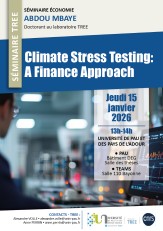
[E] Climate Stress Testing : A Finance Approach.
Le 15 janv. 2026 de 13h00 à 14h00
Abdou MBAYE (UMR TREE)
à Pau, en salle des thèses; à Bayonne en salle 110 via Teams
Abstract :
This article analyzes the impact of climate transition risk on the valuation of companies in the SBF120 index, based on carbon pricing. Using individual company data and a detailed sector classification (ICB), we conduct a climate stress test for the period 2021-2033, in line with the National Low Carbon Strategy. We consider carbon tax scenarios ranging from €45 to €100 per ton of CO₂e. Sectoral shocks to asset values induced by the carbon tax are integrated into a structural credit risk framework based on Merton (1974). The results highlight significant sectoral heterogeneity, with the most pronounced vulnerabilities affecting industrial services, basic resources, chemicals, energy, and retail, for total debt losses of between €755 million and €935 million.
[E] Cutting Free Allocation Cuts Emissions: Evidence from Phase IV of the EU ETS
Le 11 déc. 2025 de 13h00 à 14h00
Arthur WILLEMAERS (UMR TREE)
à Pau, en salle des thèses; à Bayonne en salle 110 via Teams
Abstract :
Phase IV of the EU ETS tightened the cap and reformed free allocation. In 2021, a narrower carbon leakage list and benchmark updates produced a one-off drop in realized free allocation. Using 2015 to 2023 data on Phase III and Phase IV incumbents from the EUTL, we construct a time-invariant, installation-level dose from the 2020 to 2021 change and estimate a continuous difference in differences with installation and year fixed effects. The event study shows stable pre trends, and allocation levels are essentially flat after 2021. Cutting free allocation reduces emissions. In our preferred specification, the slope after 2021 is -0.359, implying about -3.5% lower emissions for a 10 percentage-point loss of free allocation. From the perspective of the independence property, this dose response pattern indicates that, in Phase IV manufacturing with activity-linked free allocation, changes in the allocation schedule are not neutral for verified emissions. Among exposed firms with positive pre-2020 banks, we find no detectable attenuation. Aggregating to the BvD-entity perimeter, the emissions response replicates in direction and timing. In standard Orbis accounting aggregates over 2021-2023 we do not detect short-run movements within the ETS-linked perimeter. Non-ETS plants of the same entity are unobserved, so we neither establish nor rule out carbon leakage. The evidence is consistent with stronger effective carbon pricing at the installation margin under activity-linked allocation in Phase IV and provides quantitative input on the environmental effect of phasing down free allocation and the transition to CBAM
[E] Agricultural policies and biodiversity: impact of the CAP greening on bird abundance and diversity in France.
Le 27 févr. 2025
Aicha HASNI, doctorante en économie - le 27 février 2025 à 13h - en salle Chadefaud à Pau ; en visioconférence à Bayonne en salle 110 ; via Teams.
Abstract
In 2013, the European Union Common Agricultural Policy introduced a set of compulsory greening measures in its subsidies scheme in order to achieve environmental goals. We analyse the impact of this reform, and particularly the definition of Ecological Focus Areas (EFA), on bird diversity in France. We match bird observations from the French Breeding Bird Survey (BBS) to parcel level information on agricultural land use and type of crops. We exploit the heterogeneous exposure of bird observation sites to the reform depending on their ex-ante extent of arable area in a continuous difference-in-differences approach. We find evidence of an increase in overall bird abundance after 2015 in sites with a higher ex-ante proportion of arable land, driven by a small number of generalist species, and no impact on species richness and phylogenetic diversity. A decomposition by diet type suggests that vertebrate eaters were positively impacted by the reform. By contrast, cropland species experienced the most dramatic decline after 2015 in sites with a higher share of arable area. Estimations of the dynamic effects of the reform suggest that the observed positive effects on bird abundance were limited to the first two years after its implementation. Based on observational data, our findings confirm previous concerns regarding the effectiveness of the 2013 reform in preserving biodiversity.
[Doc] Carbon Leakage, Free Allocation and CBAM: Cost-Competitiveness and Green Technology Investment
Le 9 janv. 2025
Arthur WILLEMAERS, doctorant en économie - le 9 janvier 2025 à 13h - en salle des thèses, à Pau.
Abstract
"This paper develops a partial equilibrium model to examine strategic interactions of domestic and foreign firms under the European Union Emissions Trading System (EU ETS), focusing on anti-carbon leakage policies, namely free allocation and the Carbon Border Adjustment Mechanism (CBAM). Our model highlights the impact of these policies on firm competitiveness, green technology investment, carbon leakage reduction, and overall emissions. The analysis reveals that while CBAM effectively restores competitiveness, incentivizes green technology adoption, and mitigates carbon leakage, free allocation yields mixed results, with potential to increase global emissions depending on foreign emission intensity thresholds. Furthermore, we introduce a threshold for foreign emission rates, where free allocation shifts from an environmental measure to a protectionist tool and leads to an increase in global emissions. Numerical simulations confirm these strategic outcomes, showing nuanced interdependencies between policy design, investment incentives, and leakage rates. Our findings underscore the importance of coordinated policies like CBAM and highlight the need for careful design to effectively balance economic and environmental objectives."